Build a Production Rust Library in 6 Weeks

For Python, JavaScript/TypeScript, Ruby and PHP developers ready to move into systems programming. Build a JSON parser from scratch, wire it into Python, and benchmark it, with every pull request reviewed by Jim and Bob, who explain the why, not just what to change.

 Coached by Jim (Rust & C/C++ veteran) & Bob (Python–Rust coach) · meet your coaches ↓
Next cohort starts November 30, 2026 · 6 seats · ~10 hours a week
You already depend on Rust. Can you work with it?
The tools you rely on are moving to Rust: ruff, uv, Pydantic and Polars in Python; SWC, Biome and Turbopack in JavaScript; YJIT in Ruby. Debugging them, extending them, or reasoning about why they're fast is another skill entirely. Six weeks of Rust changes how you write code in every language.
A better developer in your main language
Rust forces habits that dynamic languages let you skip: explicit error handling, no nulls, clear ownership of who mutates what. After six weeks you read your Python, JavaScript/TypeScript, Ruby or PHP differently. You see where state leaks and where errors get silently swallowed.
Sharper with AI
When AI writes the code, vague thinking produces vague output. Rust's type system and ownership model train you to be precise about contracts, lifetimes and failure modes. That precision carries over to every prompt you write and every AI-generated diff you review.
And the timing is good:
- Adoption keeps climbing: among organizations in the State of Rust Survey, non-trivial Rust use went from 38.7% (2023) to 48.8% (2025).
- Rust roles skew senior and pay well: most postings target senior and staff engineers, at a premium over comparable Go and Python roles.
- The Linux kernel made Rust a core language in December 2025, and Ferrocene earned safety-critical certification for automotive and medical.
Python, Rust, and Why the Compiler Matters More in the AI Era
What you'll build
A complete, fast JSON parser in Rust, callable from Python. You ship a tokenizer, a recursive descent parser, PyO3 bindings and a benchmark suite, all reviewed through GitHub pull requests.
Parser from scratch
Tokenizer, recursive descent parser, full JSON spec. Enums, pattern matching, ownership, borrowing: learned by building, not reading.
PyO3 Python integration
The same FFI layer behind Pydantic and Polars. Create Python bindings, handle cross-language memory, and import your Rust code in Python.
Benchmarked performance
Measure your parser against Python's json module. Profile bottlenecks, optimize hot paths, and understand why Rust is fast, not just that it's fast.
See the week-by-week curriculum
Setup & Tokenization
- Project setup with cargo
- Variables & mutability
- Basic types: String vs &str
- Testing with #[test]
- Build a JSON tokenizer
Types & Errors
- Enums & pattern matching
- Option<T> and Result<T, E>
- Error handling with ? operator
- Custom error types
- Parse primitive JSON types
Ownership & Borrowing
- Structs and impl blocks
- References: & and &mut
- Ownership vs borrowing
- Memory safety principles
- Structured parser with state
Collections & Recursion
- Vec<T> and HashMap
- Iterators and loops
- Recursive data structures
- Display trait for serialization
- Parse arrays & objects
PyO3 & Python Bindings
- Foreign Function Interface (FFI)
- PyO3 crate and Python bindings
- Cross-language memory management
- Build as Python extension module
- Import and call Rust from Python
Optimize & Benchmark
- Performance profiling
- String allocation optimization
- Benchmark vs Python's json
- Documentation & examples
- Production-ready library
Tech stack: Rust, cargo, clippy, rustfmt, PyO3, maturin
What you walk away with
- A working JSON parser in Rust, built from scratch: tokenizer, recursive descent parser, full JSON spec
- Python bindings with PyO3, so you can
importyour Rust code in Python - A benchmark suite measuring your parser against CPython's
jsonmodule - A tested codebase and a reviewed GitHub history you can show an employer
- The judgment to tell when Rust is worth it, and to review the Rust AI writes for you
Standout result: a parser that beats Python's stdlib
Results vary with your experience and the time you put in. After 6 weeks, Josh Engroff's Rust JSON parser beats CPython's stdlib json module on every fixture in his benchmark suite, including three real-world files from the simdjson and serde-json corpora.
Median throughput across 30 timed batches (~100 ms each, 3 warmup batches discarded). Linux x86-64, Python 3.14. Methodology.
Josh's parser sits mid-pack of the well-known faster-than-stdlib club (orjson, msgspec, ujson). Built from scratch in 6 weeks, reviewed weekly via GitHub PRs.
View the parser on GitHub · Full benchmark report
What developers say
Code review that makes you a better engineer
This isn't a course where you watch videos and check boxes. Every week you push code, and your coaches review it.
- GitHub PR reviews: feedback on every PR that explains why, not just what to change
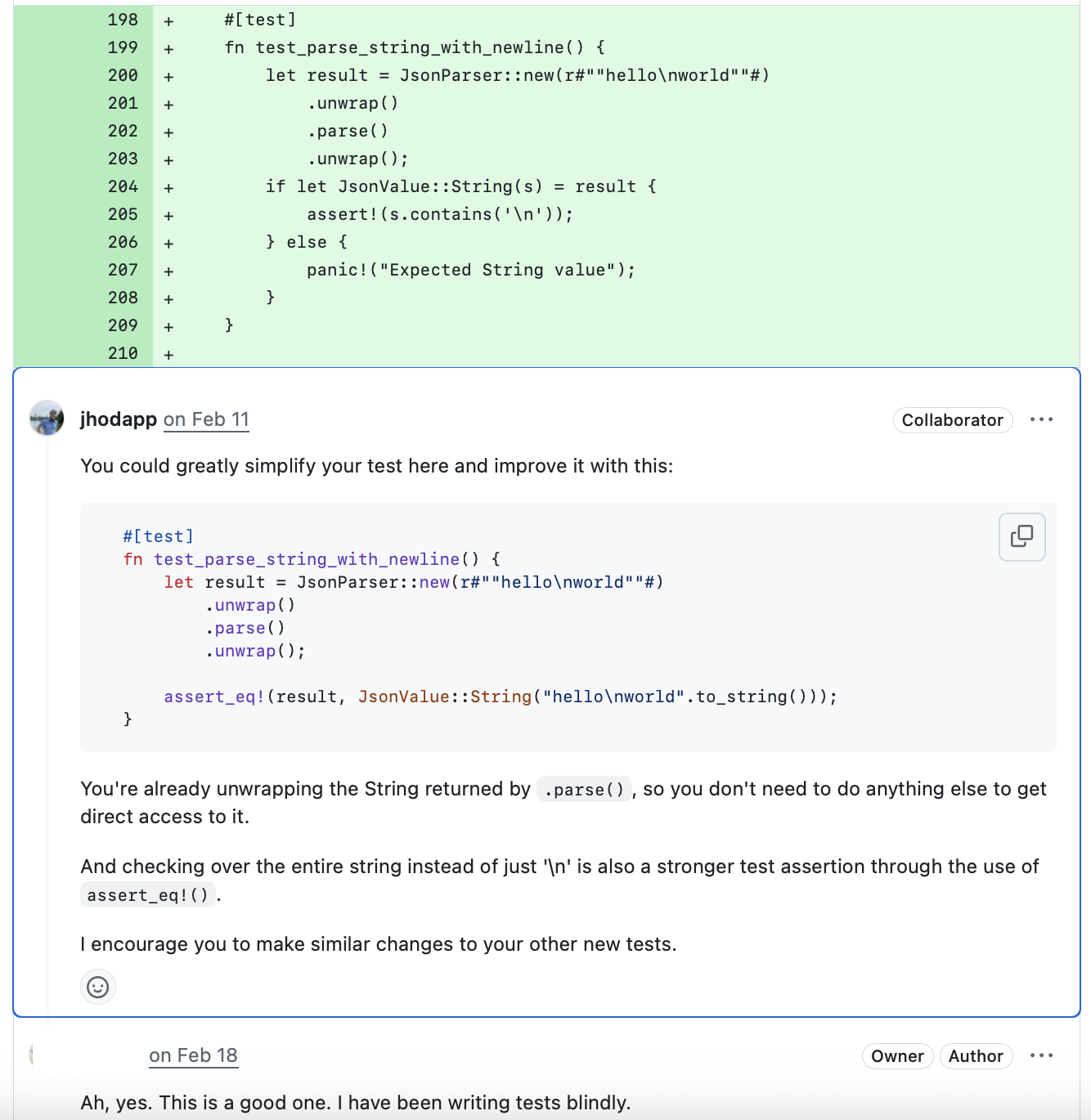
- Idiomatic Rust guidance: not just "it works" but "here's how a Rust developer would write it"
- Iterative improvement: multiple rounds of review push you toward clean, production-quality code
- Real engineering workflow: branches, PRs, code review, merge. The same process used at every serious software company.
Real reviews from the cohort, not "it compiles" but how a Rust developer thinks:
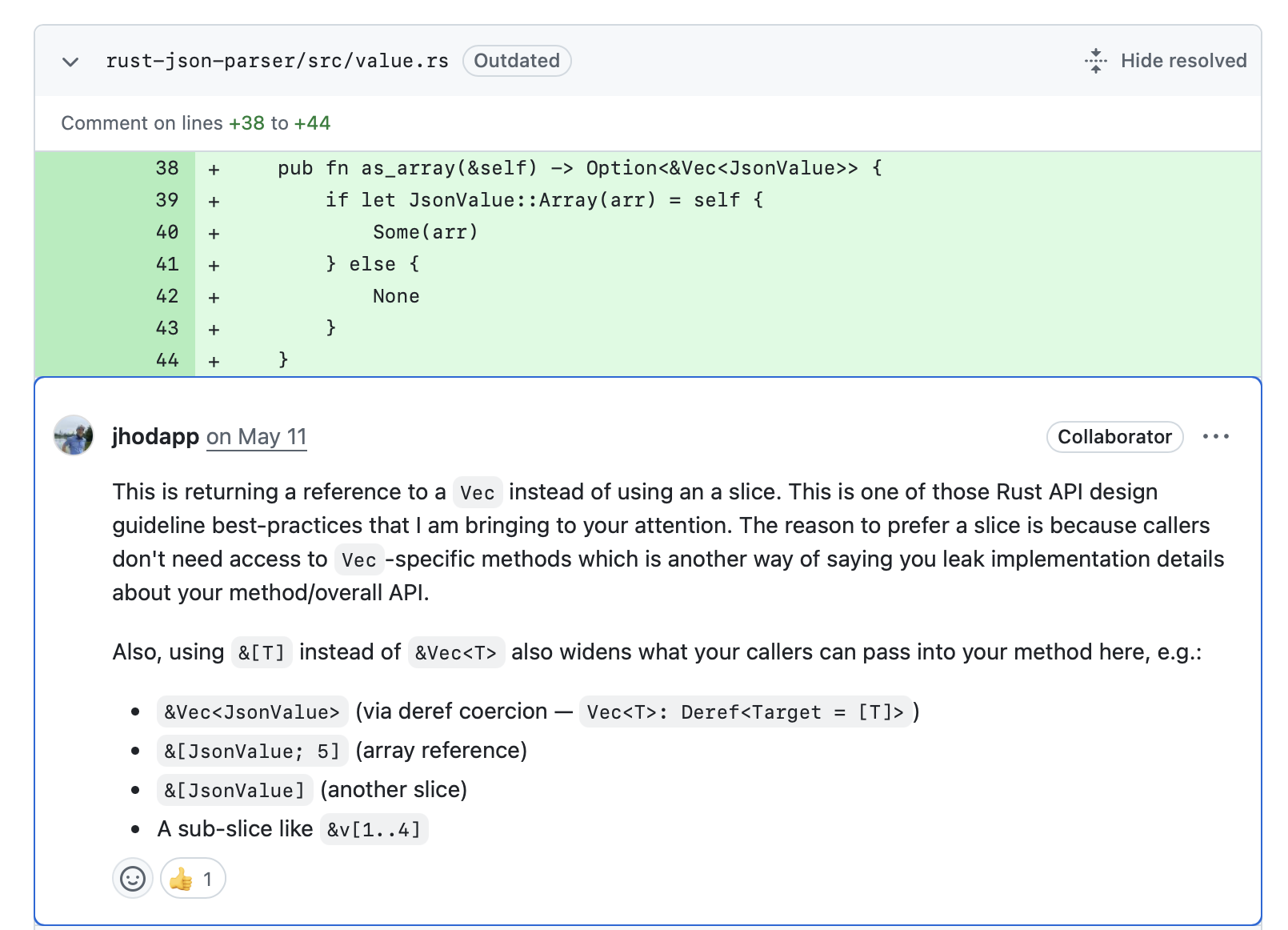
&[T] beats &Vec<T> at a boundary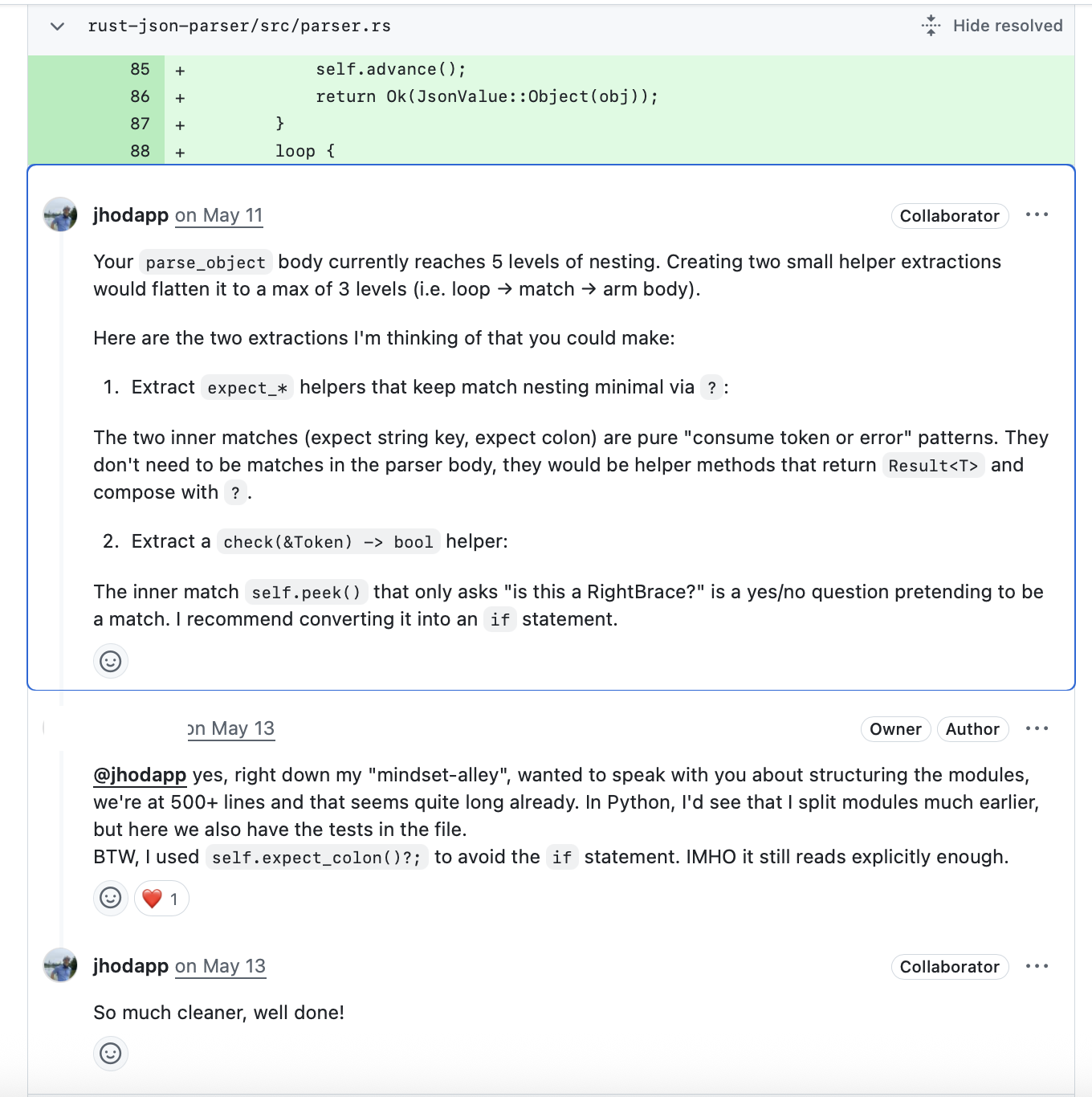
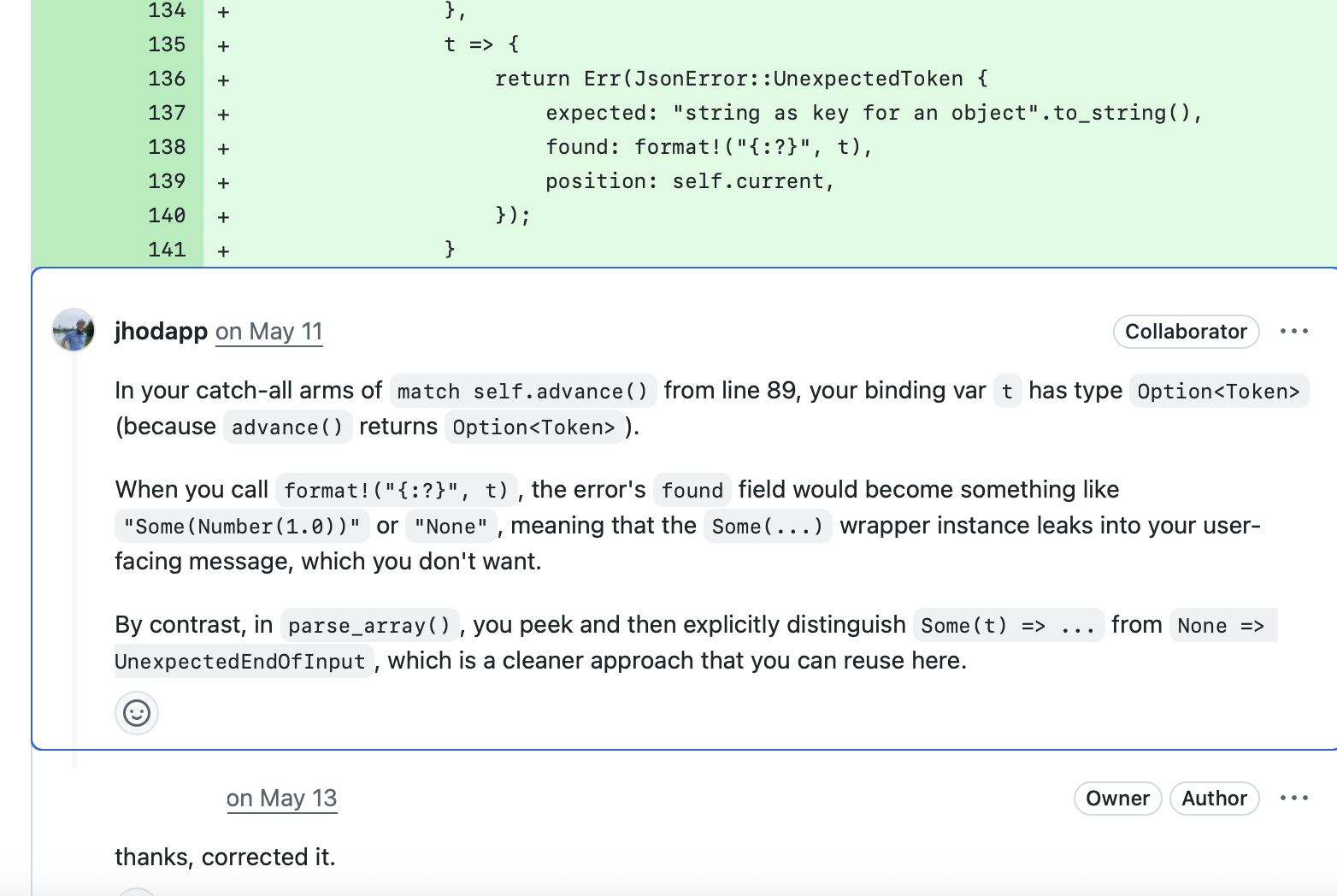
Some(...) wrapper leaking into a user-facing message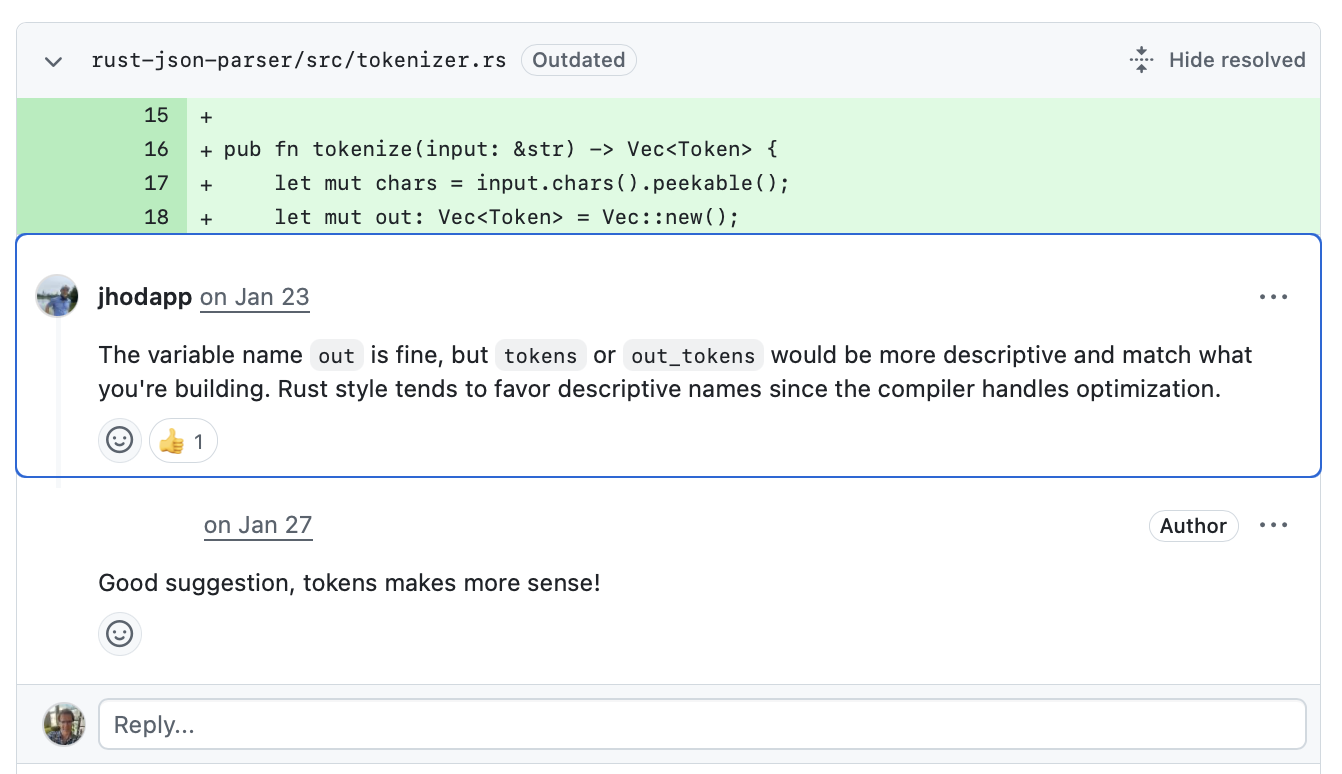
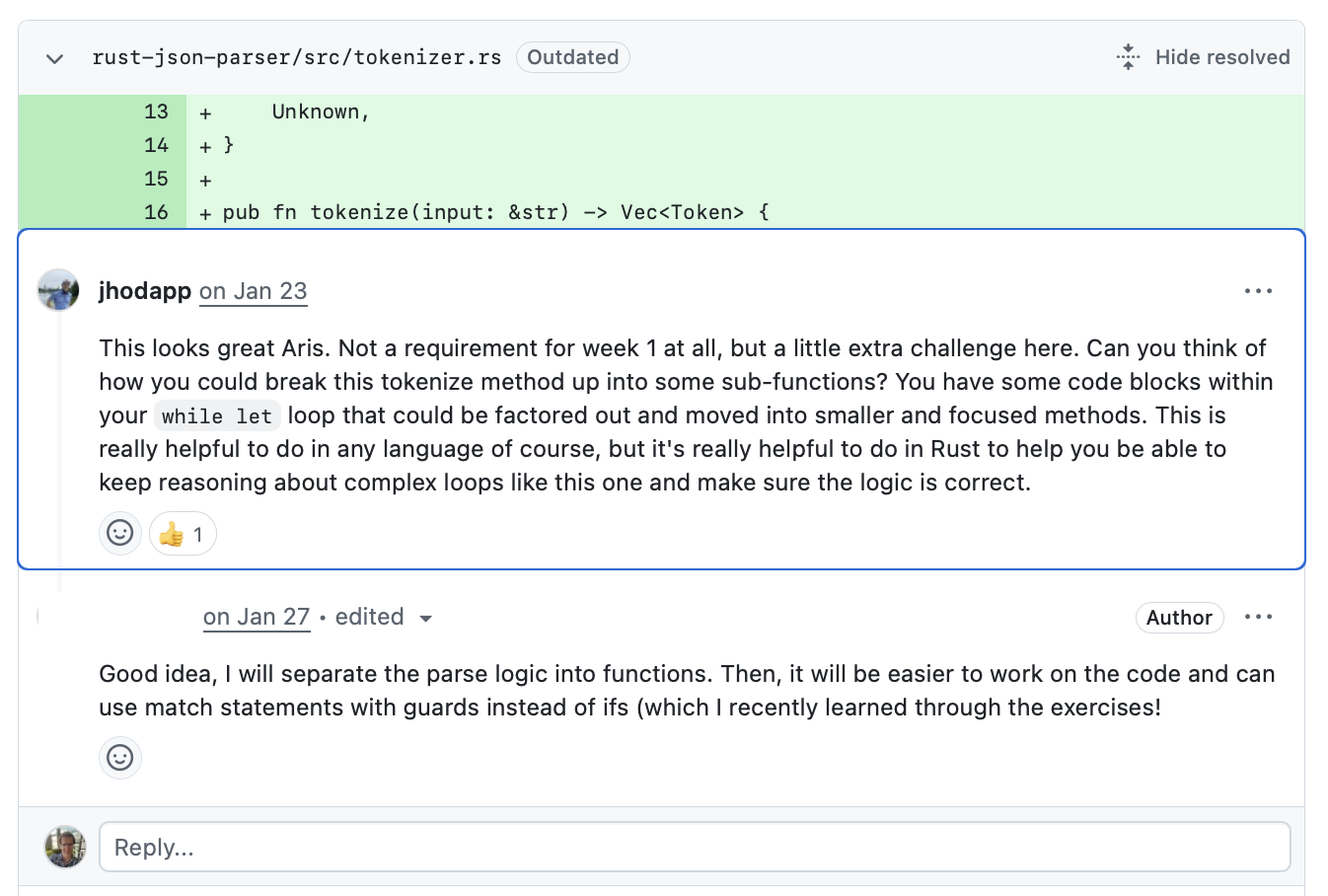
You finish with a portfolio project that stands up to scrutiny: a parser with FFI bindings, real tests, real benchmarks, and a GitHub history that shows engineering rigor. You leave thinking in two languages and writing better code in both.
Join the cohort
Six weeks, two coaches, a portfolio-ready project. What video courses can't give you: a human reading every PR you push.
€2,000 6 weeks
- Human review on every PR: why one design beats another, ownership, lifetimes, and idiomatic Rust, not just whether it compiles
- Capped at 6 developers, the high-touch attention a typical bootcamp can't give you
- Weekly group call with both coaches
- The Rust Never Sleeps Slack for peers and accountability, during and after
- 6-week structured curriculum with PyO3 integration & a portfolio JSON parser
Prefer 1:1 on your own Rust project?
Some developers bring their own Rust project, adapted to their domain, not the cohort's JSON parser. That's the 1:1 tier with Jim. Ask about it on the call.
Your coaches
Jim Hodapp: Seasoned Rust developer, open source contributor, and software engineering coach with over two decades of experience. He's worked across the stack (from GNOME and Ubuntu to embedded systems and startups) and now mentors developers through Refactor Coaching to level up both technically and professionally. Whether you're new to Rust or ready to deepen your systems programming skills, Jim brings the perspective, structure, and guidance to help you grow.
Bob Belderbos: Developer coach and builder with 10+ years at Sun/Oracle and 6+ years coaching developers to ship maintainable software. Co-founded Pybites and built its Python and Rust coding platforms (500+ exercises). 150+ developers coached. Bob brings the Python perspective and coaches on bridging Python and Rust: PyO3 integration, when to reach for Rust, and writing clean code in both languages.
Frequently asked questions
Do I need Rust experience? No. You need to be comfortable programming in another language, such as Python, JavaScript/TypeScript, Ruby, PHP or any other dynamic language. We start from Rust basics and build up through the project.
I don't write Python. Is this for me? Yes. Weeks 1–4 and 6 are pure Rust. Week 5 binds your parser to Python with PyO3; basic Python is enough to follow, and the FFI concepts carry over to other languages.
What if I fall behind? Sessions are recorded for catch-up. You also have async support from Jim and Bob throughout the week.
How much time per week? ~10 hours including the live session, coding exercises, and building your parser.
Do we work solo or in teams? Solo work on your own parser, but you learn together. The group format creates accountability and peer support.
Can my employer pay? Yes. Use our email template and one-page training brief to ask your manager, and we invoice your company directly. For teams of 4 or more we run a private cohort.
Won't AI just write the Rust for me? It will, and that's exactly why you need to understand it. Devs who let Claude or Cursor write Rust without grasping ownership, lifetimes, and zero-cost abstractions ship code they can't debug. The premium goes to engineers who can read, review, and reason about what the AI produced. Six weeks here builds that muscle.
Ready to build a real Rust library?
Tell us what you want to get out of Rust. We'll get on a call, talk through your goals, and figure out whether this cohort is the right fit.
Book your 30-min call with Bob & Jim →
Starts November 30, 2026. Already convinced? Register directly →